Build Your Family Bank by Emily Griffiths-Hamilton
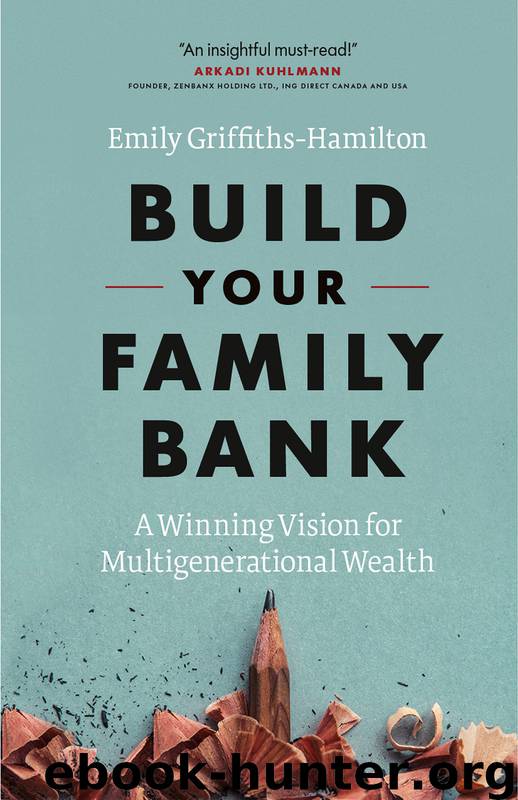
Author:Emily Griffiths-Hamilton
Language: eng
Format: epub
Tags: Personal Finance, Money Management
Publisher: Figure 1 Publishing
Published: 2014-06-16T16:00:00+00:00
7. A Common Hot Button:
The Family Cottage
It is one of those perfect days at the cottage, an idyllic summer retreat resonant with family memories. As you relax with a cool drink and a good book in the setting sun, you fondly remember the days when your young children eagerly anticipated roasting marshmallows around an open fire, fun-filled game nights and laughter over shared family dinners. The memories are powerful and emotional. Now, things seem more poignant than ever before. You think about your now grown children and perhaps your grandchildren, fearing they may one day face the loss of the cottage that has played such a significant role in weaving the fabric of your family. Is this asset going to serve second- and third-generation Family Bank members as it did you?
Here is where I insert a warning: be careful with this sentimentality. It is exactly this kind of evocative picture many professionals paint in an attempt to sell you their products. They take cunning advantage of the strong human emotions surrounding family. Every summer, these professionals produce an onslaught of glossy information circulars that promote trusts, corporations, and insurance policies all ostensibly aimed at averting the tragic loss of the beloved family cottage. Families using the Family Bank approach, however, are armed with the knowledge that the family cottage will be assessed like the family’s other financial assets. Its genuine value will be measured against the shared vision your family has developed.
Estate-planning advisors, whether dealing with accounting, legal, or financial aspects, commonly recommend trusts as a way to protect against the loss of the family cottage. These advisors are referring to the actual loss of the family cottage if the family members must sell it in order to pay estate taxes upon the death of the owner. In Canada, a tax becomes payable on the property when the property owner dies, based on a capital gain. This gain is calculated as the difference between the original cost of the property, plus any enhancements, and the fair market value of the property at the time of the owner’s death. Using a common scenario, a family cottage owned by the parents over a period of fifty years or so, and enjoyed by their children, their children’s spouses, and their grandchildren during that time, can generate a significant tax bill for the parents’ estate. This situation has created some financial concern for families, since the cost of recreational properties in many regions has increased substantially over the last fifty years.
The general theory behind using a trust structure is that by putting the family cottage in a trust, the tax can be deferred. Note I said deferred here, though, not eliminated. Deferring the tax on the cottage does not mean the tax is permanently avoided. Under current Canadian tax laws, it means that the tax will be due in twenty-one years, at the tax rates applicable then. So, while you may be protecting an asset of the Family Bank for a few years, by placing your cottage in a trust, you are also creating a future liability.
Download
This site does not store any files on its server. We only index and link to content provided by other sites. Please contact the content providers to delete copyright contents if any and email us, we'll remove relevant links or contents immediately.
The Brazilian Economy since the Great Financial Crisis of 20072008 by Philip Arestis Carolina Troncoso Baltar & Daniela Magalhães Prates(140268)
International Integration of the Brazilian Economy by Elias C. Grivoyannis(111064)
The Art of Coaching by Elena Aguilar(53255)
Flexible Working by Dale Gemma;(23293)
How to Stop Living Paycheck to Paycheck by Avery Breyer(19731)
The Acquirer's Multiple: How the Billionaire Contrarians of Deep Value Beat the Market by Tobias Carlisle(12331)
Thinking, Fast and Slow by Kahneman Daniel(12311)
The Radium Girls by Kate Moore(12033)
The Art of Thinking Clearly by Rolf Dobelli(10490)
Hit Refresh by Satya Nadella(9140)
The Compound Effect by Darren Hardy(8975)
Tools of Titans by Timothy Ferriss(8402)
Atomic Habits: Tiny Changes, Remarkable Results by James Clear(8349)
Turbulence by E. J. Noyes(8056)
A Court of Wings and Ruin by Sarah J. Maas(7854)
Change Your Questions, Change Your Life by Marilee Adams(7786)
Nudge - Improving Decisions about Health, Wealth, and Happiness by Thaler Sunstein(7711)
How to Be a Bawse: A Guide to Conquering Life by Lilly Singh(7490)
Win Bigly by Scott Adams(7202)
